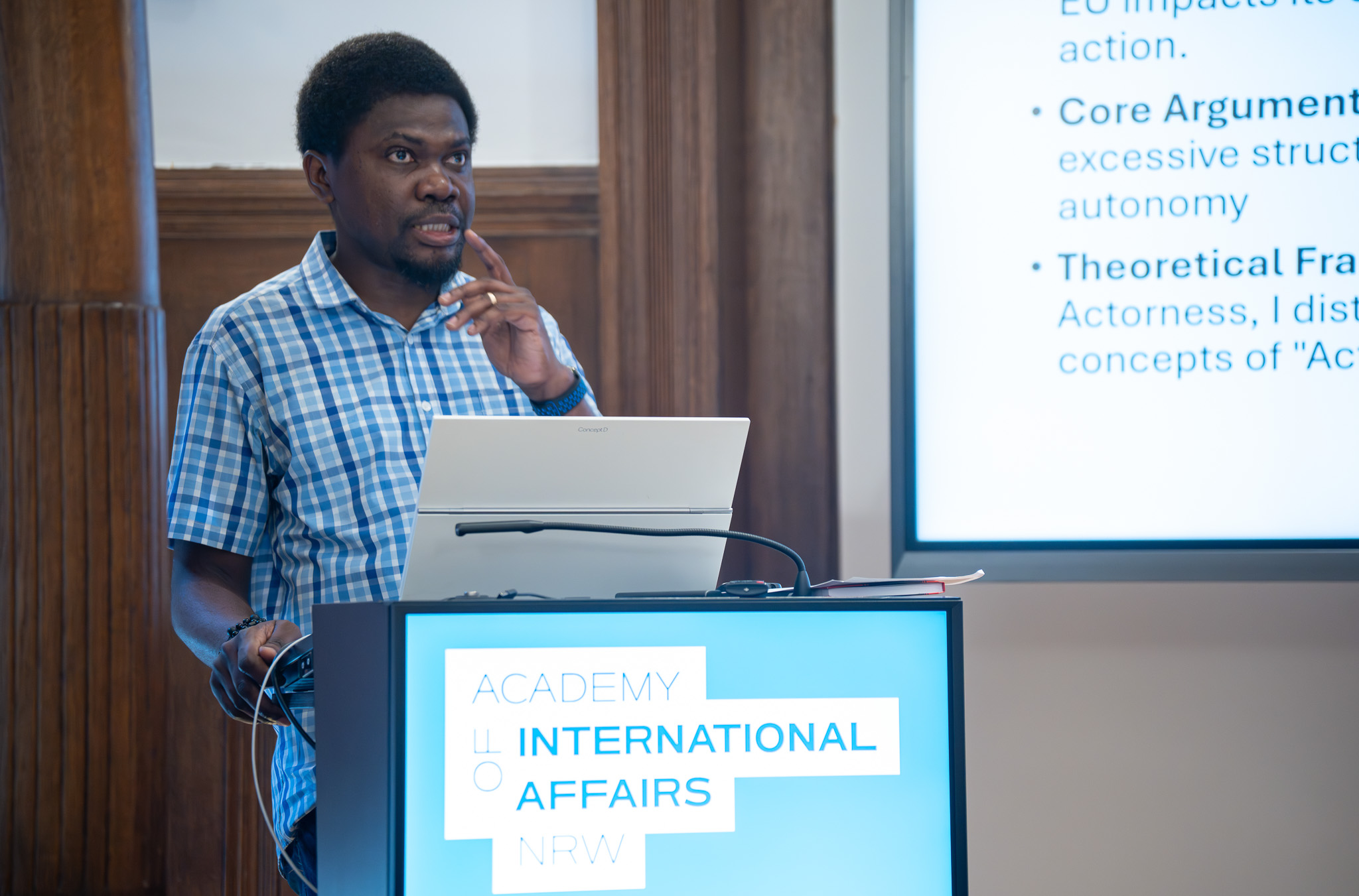
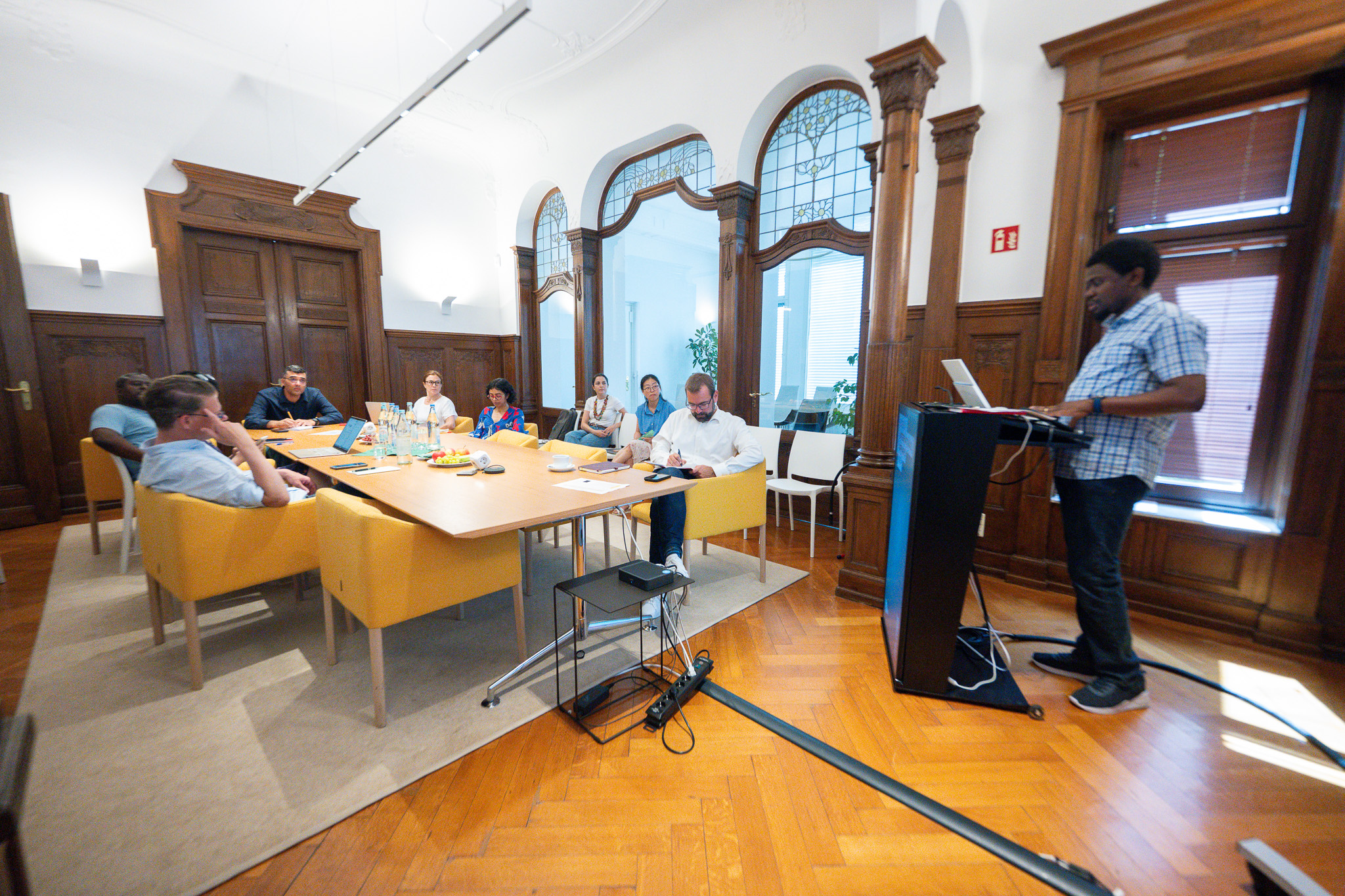
Adiatu Aliru Abiodun deals extensively with the ambivalent role of European funding mechanisms in the relationship between the European Union (EU) and the African Union (AU). In his project presentation at the AIA Colloquium, he highlighted that the support instruments provided by the EU had on the one hand significantly contributed to supporting regional integration processes in Africa and enabling short-term political as well as institutional progress. Through financial support, numerous programs to promote peace, security, governance, and economic cooperation could be implemented. These measures strengthened the AU’s capacity to act in certain policy areas and promoted cooperation between member states. In this sense, European funding mechanisms have made an important contribution to the stabilization and further development of regional structures on the African continent. On the other hand, Adiatu Aliru Abiodun also emphasized that the same financing structures create a problematic dependency in the long run.
The strong financial imbalance between the EU and the AU means that key activities and programs of the AU remain heavily reliant on external funders. This leads to structural limitations in independently shaping political priorities and strategies. Although the EU recognizes the AU as an important international actor on a normative and political level and explicitly supports its role in multilateral processes, the AU’s actual capacity to act is still limited by its financial dependence. The study’s results thus confirm the assumption that high recognition of actorness does not necessarily go hand in hand with corresponding empirical agency. Rather, the AU’s ability to act independently and pursue its own political goals is structurally impaired by the existing funding arrangements. Against this backdrop, Adiatu Aliru Abiodun stressed that achieving genuine strategic autonomy for Africa requires a fundamental change in current financing structures. In the long term, the AU needs to strengthen its financial independence and overcome its reliance on external donors in order to pursue its political and economic development goals on its own terms.
This is especially important with regard to implementing Agenda 2063. The agenda aims for sustainable development in Africa based on African responsibility, self-determination, and agency. However, as long as strong financial dependence persists, achieving these goals remains at risk. Financial independence is therefore an essential prerequisite for successfully implementing the vision of a self-determined and sustainably developed Africa as outlined in Agenda 2063.
Benjamin Westhoff

Benjamin Westhoff

Benjamin Westhoff
Benjamin Westhoff

Benjamin Westhoff