Skip to content

Publication type: AIA Publications

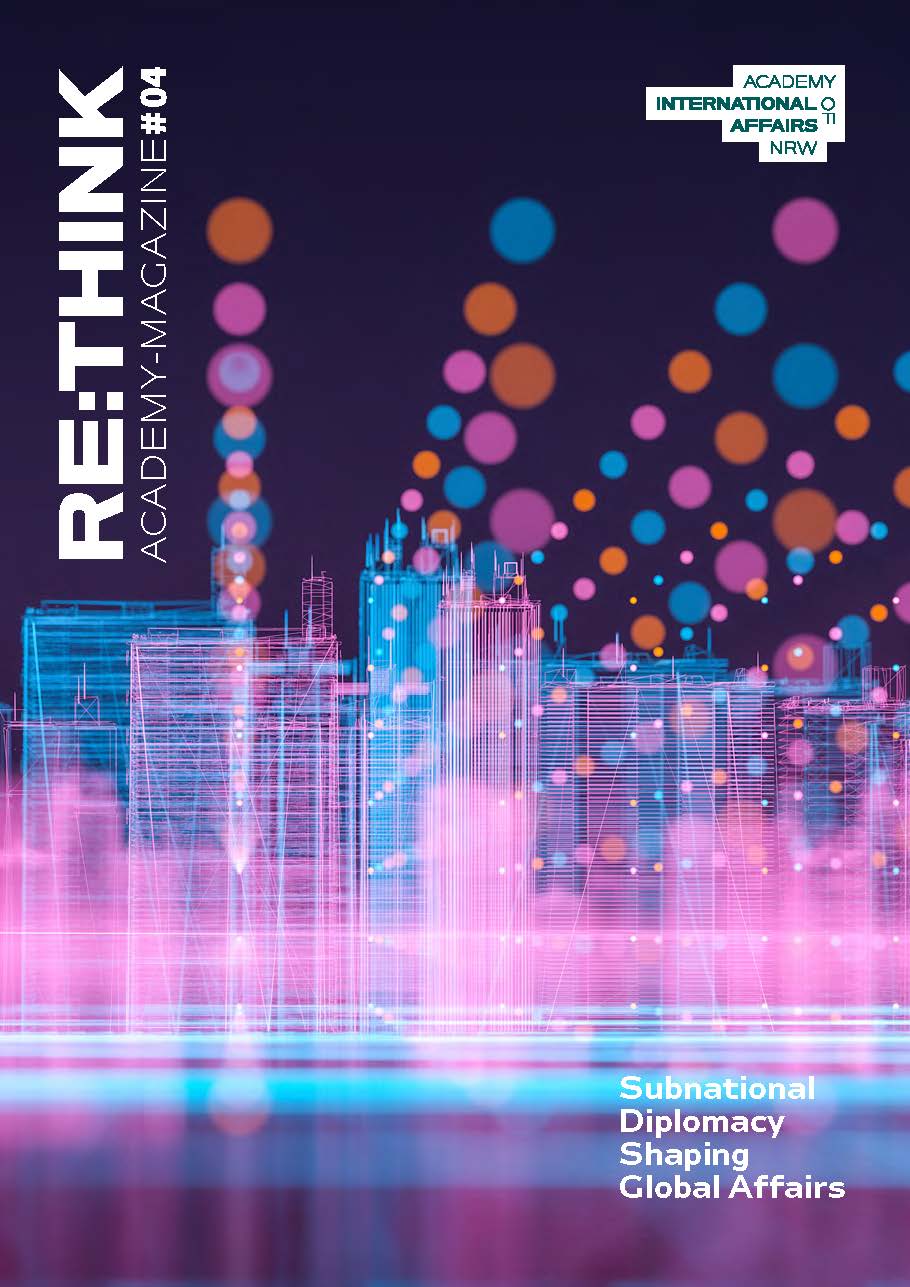
Subnational Diplomacy Shaping Global Affairs

This year’s RE:THINK Academy Magazine explores how power is shifting away from national capitals. From Duisburg’s resilient China partnership to Budapest’s Pride parade as an act of city diplomacy, the issue traces how cities, regions, and networks are increasingly shaping international affairs once reserved for states. Highlights include Navid Kermani’s harrowing account of the war …

Strategic Coherence and Distributed Influence

This paper contributes to the European Commission’s review of its 2016 Joint Communication on international cultural relations. Drawing on a comparative study of soft power governance across twenty-five jurisdictions (British Council, 2026), which applies an Assets-Infrastructure-Outcomes framework, and on a practitioner-academic workshop convened in Brussels in March 2026, it argues that the review requires a …

Reconfiguring European Security

The European security environment has undergone significant transformation following Russia’s 2022 invasion of Ukraine, particularly amid rising uncertainty over the credibility of US security commitments. This paper examines the drivers of Europe’s current security dilemma—marked by Russian coercion and doubts about US commitment—and explores possible pathways to strengthen European security. As an answer, we propose …

Beyond Culture – Rethinking the EU’s Approach to Soft Power in a Turbulent World

The European Union is beginning a review of its 2016 Joint Communication on international cultural relations. This policy brief argues that the review presents an opportunity to reconceive the scope and purpose of EU-level coordination of international engagement. Drawing on a 25-jurisdiction comparative study published by the British Council in March 2026 (the ‘Trends study’) …

Order and Ideology

Why the Trump Administration is Redefining American Power and Purpose This paper analyses the foreign policy orientation of the second Trump administration. It argues that this does not represent an attempt at reform, but rather a fundamental departure from the liberal international order that has existed since the Second World War. Contrary to initial assumptions, …

City Clusters in China-Germany Subnational Diplomacy

This paper offers a new framework for understanding China-Germany sister-city diplomacy through the lens of city cluster logic, enabling subnational actors to navigate complex institutional structures and networked partnerships more strategically. Drawing upon a comprehensive policy analysis and a series of 68 interviews conducted in Germany and China between 2022 and 2025, this study illuminates …

Tradition, State, and Justice: Rethinking Statehood through Hybrid Governance in Nigeria and Pakistan

Hybrid governance in Nigeria and Pakistan has not only persisted as a legacy of colonial state formation but has also evolved into a complex system of shared authority between state institutions and traditional, religious, and community actors. This evolution reflects a qualitative shift toward negotiated governance, where Emirs, Obas, vigilante groups and jirgas play central …

How the United States’ and Germany’s Politics Got Upended

The most recent national elections in two of the world’s leading economic powers and democratic stalwarts—Germany and the US—saw ethnonationalist parties closing in on taking power. The recent rapid rise in support for Germany’s radical right AfD party; and the success of Donald Trump’s MAGA movement now threaten to bring the institutional pillars and norms …

The Postmortem of the Nord Stream Projects

This paper presents a postmortem analysis of the Nord Stream 2 (NS2) pipeline project, examining its political, economic, and security implications within the Baltic Sea Re-gion (BSR) and the broader European Union (EU). Initially framed as an essential part of Ger-many’s energy transition, NS2 evolved into a symbol of geopolitical miscalculation and intra-EU discord. The …

Embedding Urban and Subnational Diplomacy in a Multi-Level Governance Framework

Promoting urban and subnational diplomacy within a coordinated and synergetic multi-level governance framework is an important way to address global interconnected risks and challenges. Given the different nature, interests and positions of cities, subnational regions, national states and international organizations, their visions and ideas can substantially diverge from each other in some points. In a …

RE:THINK Academy Magazine #03

This issue explores pressing global dynamics across outer space governance, climate transformation, and conflict resolution. Articles examine the urgent need for security frameworks in space, Europe’s autonomy in orbit, and environmental perspectives beyond Earth. Simultaneously, it addresses structural change, geopolitical energy shifts, democratic engagement, and innovative approaches to diplomacy and peacebuilding from Ukraine to the …

Between Stability and Change

This paper examines Chad’s 2022 National Dialogue (Dialogue National Inclusif et Souverain, DNIS) as a case study of the use of so-called “National Dialogues” during political transitions. After providing an analytical overview, the study finds that Chad’s dialogue largely served to legitimize the existing military-led regime rather than to effect genuine systemic change. The convened …

Grasping the Nettle – Deepening Chinese-Russian Ties and the EU’s Need to Respond

The China-Russia partnership post-2022 has not only seen a quantitative increase in trade volumes, but also a qualitative shift towards a more sophisticated partnership in new technologies, innovation, and research and development (R&D) in domains such as artificial intelligence (AI), green hydrogen energy, e-commerce, etc. This may introduce new strategic, economic and security risks for …

As the US Government Joins “Team Authoritarian” – Here’s How to Maintain an International Rules-Based Order

To effectively counter economic competition, global security threats, and assaults on the rules-based global order from authoritarian nations, democratic allies must work together to build support and push the adoption and integration of two core national strategies: 1) building stronger domestic economies and strengthening democracy within nations- through large-scale inward place-based investments in people, innovation …

The EU’s Need for a Strategic Shift towards China and Russia

The growing cooperation between China and Russia post-2022 has not only seen a quantitative increase in trade volumes, but also a qualitative shift towards a more sophisticated partnership in new technologies, innovation, and research and development (R&D) in domains such as Artificial Intelligence (AI), quantum computing, green hydrogen energy, etc. This may introduce new strategic, …

Enhancing EU-Africa Cooperation in Renewable Energy under the European Green Deal

The European Green Deal (EGD) presents a transformative framework for sustainable energy transitions, offering a unique opportunity for enhanced collaboration between the European Union (EU) and Africa. This partnership is essential in addressing global energy challenges, particularly in light of shifting geopolitical landscapes and the urgent need for energy security. Africa’s vast renewable energy potential …

Chinese and other foreign investments in Africa’s development

Africa has become a focal point of foreign investments, particularly from China whose economic engagement with the continent has surged in recent years. However, the disproportionate focus of these investments on resource extraction raises concerns about long­-term benefits for Africa. This paper examines the development implications of Chinese investments, with a focus on employment. The …

Strategic Identity Narratives Through Time

This paper illustrates how studying the evolution of strategic narratives – stories that states tell in their diplomatic communication to convince publics at home and abroad to frame their views and actions – can provide valuable insights into diplomatic developments. Rhetorical shifts often precede political shifts and can help identify opportunities to influence foreign policy. …

Religion, War, and International Relations

How does the field of study of International Relations (IR) engage with questions of religion and war? This paper addresses the long neglect the field experienced in terms of including religion in its research agenda and presents the increase of interest and approaches which has emerged in the last two decades. By including work from …

RE:THINK Academy Magazine #02

In this second issue of our magazine, you will find numerous articles and interviews dealing with current conflicts and suggestions for ways forward in global politics. The role of the Eastern and Central European states in the face of Russia’s war of aggression against Ukraine is once again a central topic, which we examine from …